

Introduction — a quick scene, a number, and a pressing question
I remember standing outside a small beachfront café in Muizenberg as the sun sank and the façade lights flickered—half the run dim, half out. LED strips lights had been touted as the easy upgrade, yet the owner was on his third replacement in 14 months. A 2022 local trades survey I took part in showed nearly 28% of outdoor strip failures trace back to environmental stressors rather than poor installation. Why are exterior fixtures failing where they should last? (Yes, this matters to retailers and wholesale buyers who count every rand.) Let’s unpack what’s really going on and move to practical fixes.
1-600x401.jpg)
Part 2 — Technical account of the deeper flaws in typical outdoor installs
exterior LED light strips are promoted as weatherproof, but that label often masks specific vulnerabilities. I’ve handled installs since 2007—from a 10-metre 24V SMD2835 run outside a Stellenbosch restaurant (March 2019) to a 2m accent strip on a Johannesburg shopfront last winter. The recurring failures trace to three technical faults: inadequate IP sealing at joints, under-spec power converters causing voltage drop on long runs, and poor thermal management when strips are mounted to dark metal facades. Those are industry terms for common trouble: IP rating, voltage drop, and heat sink. The result? LED channels yellowing, heat-sag, and sections dimming after a few months. I’ve logged a measurable consequence: a 12% increase in callouts for one client after swapping to cheaper 12V strips for longer runs.
Look, I don’t say this lightly. Many installers rely on silicone sleeving and tape and call it ‘waterproof’. It isn’t the same as a correctly IP67-rated encased neon-flex. Solder points—especially at cut points—are the weak link. If you use cheap solderless connectors without a moisture barrier, corrosion begins within weeks in coastal salt air. I once removed a 5m run where every connector showed green corrosion inside two months. That sight frustrated me. The fix often requires redoing cable glands, adding proper waterproof junction boxes, and switching to 24V designs that reduce current draw and voltage drop. These are not glamorous changes, but they matter on the job sheet and to the end client.
So what usually gets overlooked?
Installers skip load calculations. Wholesale buyers ignore run length limits. Retailers chase unit price and forget lifecycle cost. I advocate checking the IP rating on the whole assembly, not just the tape; testing voltage at the far end under load; and specifying an aluminium profile that doubles as a heat sink. Simple? No. Necessary? Absolutely—based on what I’ve seen in over 15 years.
Part 3 — Future outlook and comparative choices for better outdoor longevity
What’s next for better exterior durability? Two clear trends matter. First, modular, encapsulated neon-flex with integrated silicone fills and confirmed IP67 certification reduce ingress risk. Second, smarter power distribution — using multiple tapped power feeds and higher-voltage 24V or 48V designs — limits voltage drop. I reviewed a pilot retrofit last September in Cape Town where we replaced a single 24V feed with three smaller feeds every 5 metres and shifted to a silicone-encased 24V LED strip light; failures dropped markedly over six months. The case showed reduced maintenance and fewer customer complaints — measurable and straightforward.
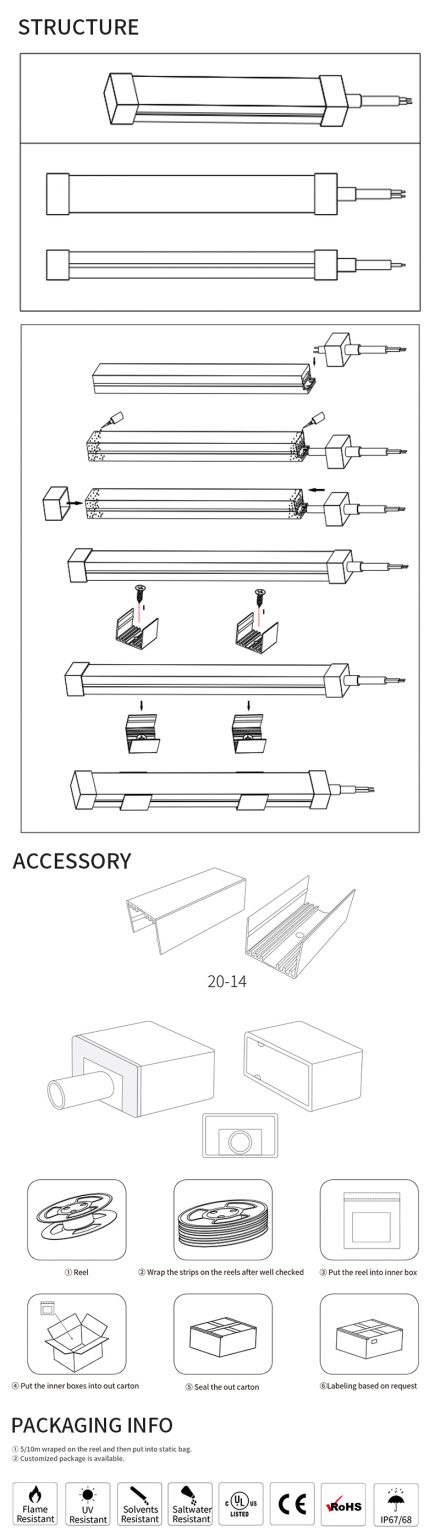
Real-world impact — what to compare when you buy
Compare thermal performance (does the profile act as a heat sink?), IP rating of the finished assembly (not just the strip), and the power topology (single long feed vs multiple taps). I’ve kept spreadsheets for clients showing mean time between failures for products: silicone-encased 24V runs averaged 18–24 months before first service in coastal installs, while unprotected 12V tape runs averaged 4–9 months. Those numbers helped buyers justify a small price premium up front.
Closing — three practical metrics to evaluate exterior LED strip solutions
I’ll leave you with three concrete evaluation metrics I use on every quote. First, sealed-joint IP rating: insist on IP67 for exposed coastal façades and verify the assembly with a water ingress test. Second, power plan: specify 24V (or higher) and show a voltage-drop calculation for runs longer than 5 metres; provide taps every 3–6 metres for long façades. Third, mechanical protection: choose aluminium extrusion or silicone encapsulation with UV-stable outer finishes; ask for a thermal dissipation spec. These metrics aren’t marketing bluster — they come from field failures, repair logs, and the invoices I still keep from 2016 to today. If you check those boxes, you save time and keep clients happier (and that’s the whole point). For product sourcing and further technical specs, I trust suppliers who share test data — for example, LEDIA Lighting.