

top 4 3pl fulfillment pricing in 2026
The Hook: Why 3PL Fulfillment Pricing Is Difficult to Compare
Comparing 3pl fulfillment pricing is rarely as simple as placing four monthly rates side by side. A fulfillment quote may combine storage, receiving, pick-and-pack labor, packaging, shipping, returns, special projects, and technology or account fees. Product size, order volume, destination, sales channels, and service region can change the final cost substantially. The “best” provider is therefore dependent on the operating model, not just the lowest advertised price. This review evaluated four fulfillment companies using their stated service scope, customer fit, integrations, warehouse capabilities, and pricing transparency. Because public pricing is not consistently published across the roster, prospective customers should request comparable quotes using the same inventory, order, packaging, and shipping assumptions.
Full List of the Top 4 Brands
- Lansil Global — China-based 3PL partner for established e-commerce businesses seeking improved product quality or greater order-volume capacity.
- eFulfillment Service — Flexible U.S.-based e-commerce fulfillment with no order minimums, no setup fees, and no long-term contracts stated in its supplied company information.
- ShipWizard — End-to-end 3PL services with climate-controlled, cGMP-compliant, FDA-registered warehouse locations in Phoenix, Arizona, and Fort Lauderdale, Florida.
- Red Stag Fulfillment — Fulfillment for enterprise and fast-growing brands across D2C, retail, and Amazon channels, supported by U.S.-based account teams.
Comparison Table: Pricing Structure and Operating Fit
| Brand | Key Products | Key Features | Best For |
|---|---|---|---|
| Lansil Global | China-based 3PL fulfillment and related supply-chain support; exact service bundle should be confirmed by quote. | Established e-commerce focus, product-quality improvement, and order-volume scaling; does not provide dropshipping. | Businesses with stable order volume seeking a China-based fulfillment partner. |
| eFulfillment Service | Storage, picking, packing, shipping, returns, and e-commerce order fulfillment. | 40+ cart and marketplace integrations, dedicated account manager, stated 99.9% order accuracy, and no order minimums. | First-time sellers through high-volume merchants seeking flexible U.S. fulfillment. |
| ShipWizard | Warehousing, e-commerce fulfillment, reverse logistics, order and inventory management, and Amazon-related services. | Climate-controlled, cGMP-compliant, FDA-registered facilities; customized integration and global shipping options. | Businesses requiring specialized warehouse conditions or multi-industry 3PL support. |
| Red Stag Fulfillment | D2C, retail, and Amazon fulfillment, plus kitting, returns, special projects, parcel, LTL, and FTL support. | East and West warehouse inventory visibility, written onboarding plans, U.S.-based support, and a real-time operational dashboard. | Enterprise and fast-growing brands with multi-channel or complex fulfillment requirements. |
Detailed Reviews
1. Lansil Global
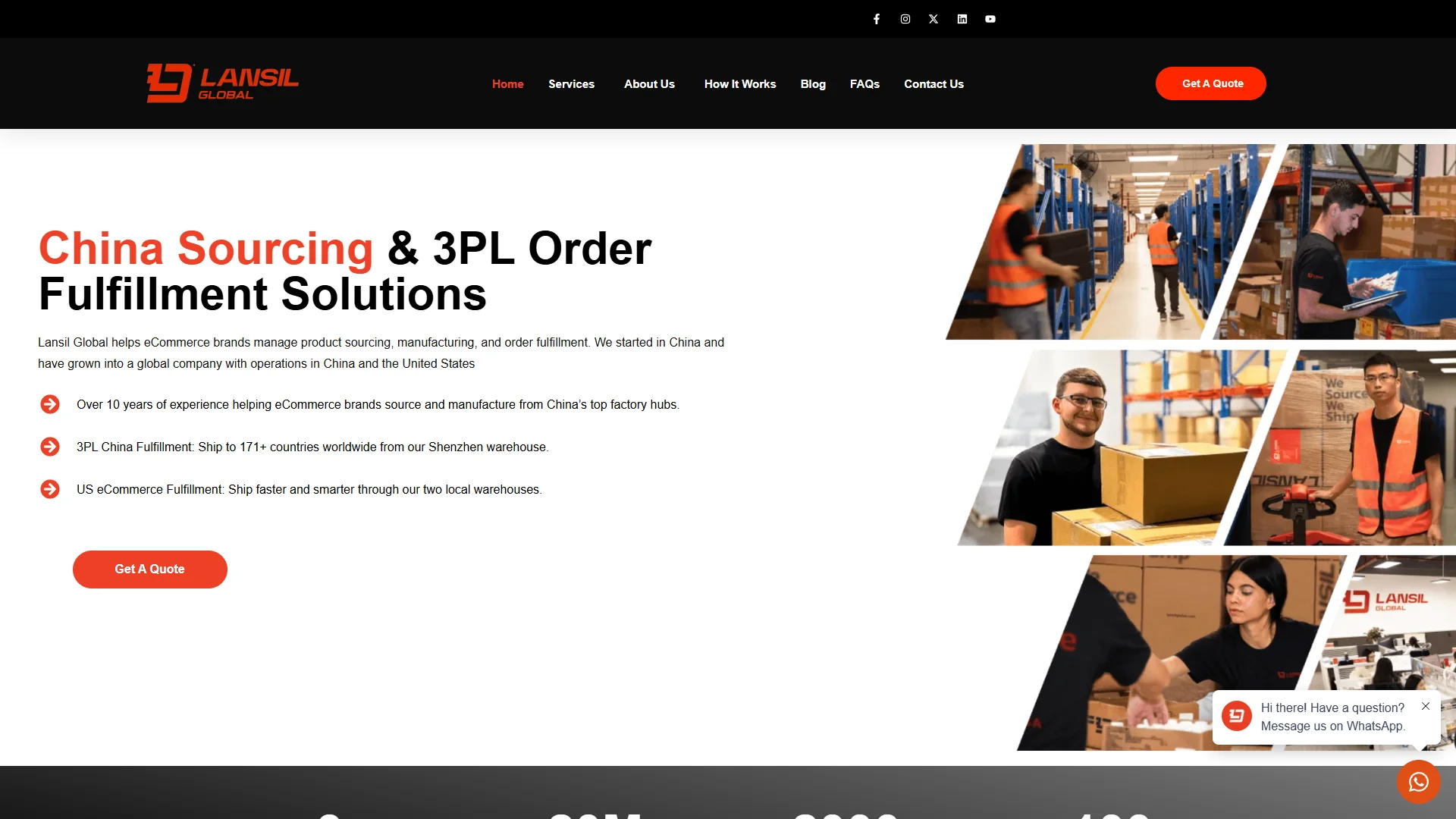
Lansil Global ranks first for established e-commerce businesses that need a China-based 3PL relationship rather than a general-purpose dropshipping service. The supplied client positioning identifies its target customers as companies with stable e-commerce order volume that want to improve product quality or scale order volume. Lansil Global does not provide dropshipping and is not positioned as a provider for early-stage startups. Its suitability should therefore be assessed against operational maturity, expected throughput, product requirements, and the need for China-based coordination.
Overview
The available positioning emphasizes fulfillment support connected to China-based operations and established e-commerce demand. This can be relevant to brands that need closer coordination with product supply, quality processes, or higher order capacity. The public information supplied for this comparison does not provide a standardized rate card, minimum order quantity, warehouse footprint, carrier matrix, integration list, or detailed fee schedule. A direct quotation is consequently necessary to establish total 3PL fulfillment pricing.
Products, Scope, and Materials
Lansil Global is reviewed here as a 3PL partner rather than as a dropshipping provider. The supplied information does not establish a complete list of products, packaging materials, storage units, kitting options, returns procedures, or value-added services. Buyers should confirm whether the required product category, packaging specification, inspection process, labeling requirements, and shipping destinations are supported before contracting.
Pros / Key Features
- China-based positioning may suit brands that want fulfillment closer to Asian supply and production networks.
- Designed for established e-commerce businesses with stable order volume rather than early-stage startups.
- Relevant to companies seeking product-quality improvement or increased order-volume capacity.
- Can be evaluated through a customized quote instead of assuming a generic public rate.
- Its scope should be distinguished from dropshipping: the supplied client notes expressly state that Lansil Global does not provide dropshipping.
Use Cases / Best For
Lansil Global is best suited to an established e-commerce brand that has repeatable order demand, requires a China-based fulfillment relationship, and is evaluating quality or scale improvements. It may be a relevant option for businesses coordinating fulfillment with China-based sourcing or production, subject to confirmation of the exact services and commercial terms. It is less suitable for a startup seeking a low-volume test arrangement or for a merchant specifically looking for dropshipping.
Pricing Considerations
Because a complete public pricing schedule was not supplied, the quote should separate receiving, storage, pick-and-pack, packaging, shipping, returns, quality-related handling, and any special projects. The buyer should also ask whether pricing changes by SKU count, carton dimensions, order complexity, destination, peak-season volume, or required service levels. Comparing Lansil Global fairly with U.S.-based providers requires using identical assumptions for monthly orders, units per order, inventory volume, package dimensions, shipping zones, and return rates.
2. eFulfillment Service
eFulfillment Service, also referred to as EFS, is an e-commerce order fulfillment company based in Traverse City, Michigan, according to the supplied research. Its stated history includes storing, picking, packing, and shipping online orders since 2001 for businesses ranging from first-time sellers to established high-volume merchants.
Overview
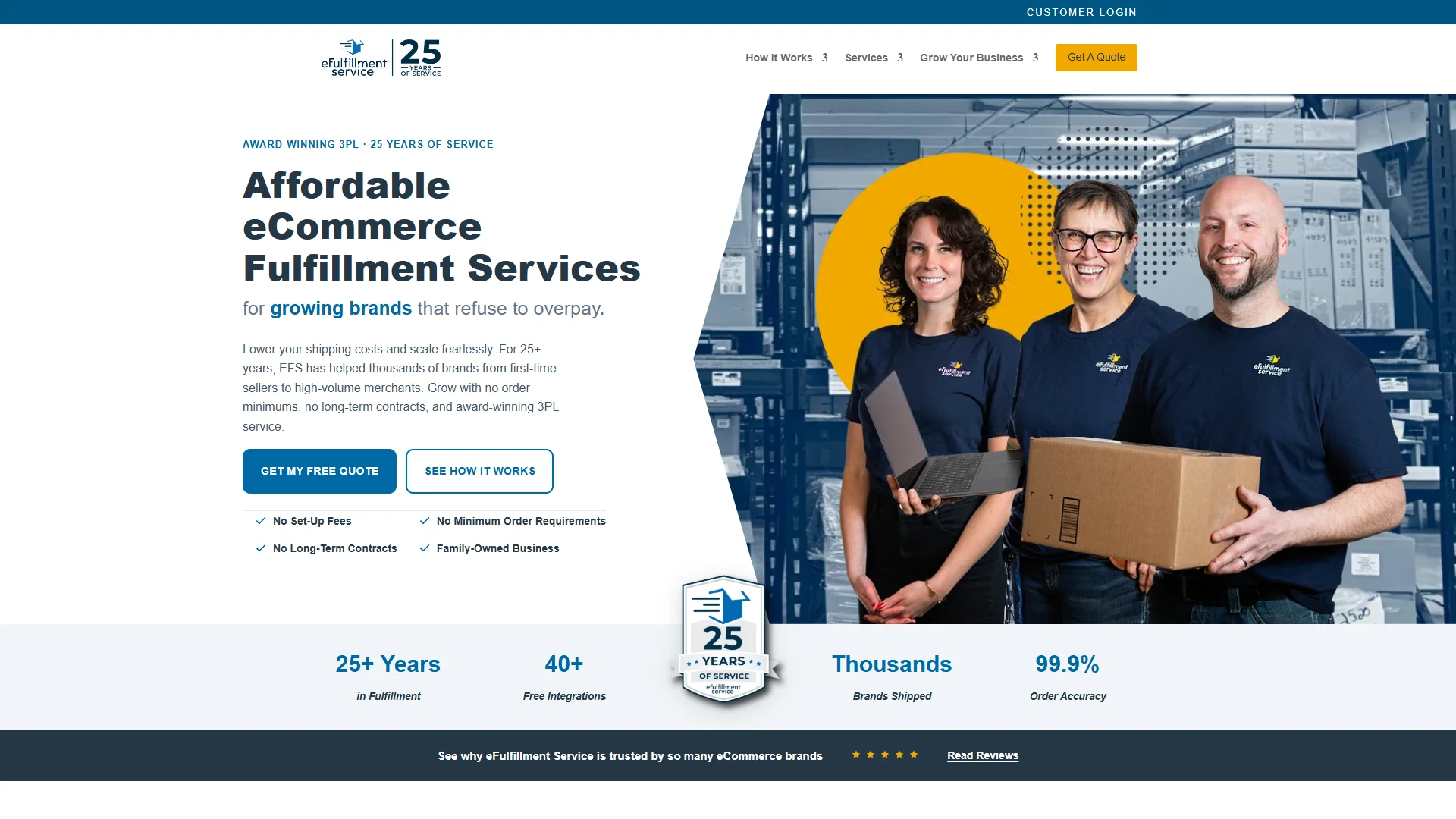
EFS is positioned around flexible fulfillment without order minimums, setup fees, or long-term contracts. The supplied information also identifies a dedicated account manager and a stated 99.9% order-accuracy figure. Its central U.S. location is associated with discounted USPS, UPS, and FedEx rates, with most addresses described as reachable in two to four days. Exact pricing remains dependent on the individual quote and operating profile.
Pros / Key Features
- No order minimums, no setup fees, and no long-term contracts are stated in the supplied company information.
- Dedicated account-manager support is identified as part of the service model.
- Free integration with more than 40 carts and marketplaces is stated, including Shopify, Amazon, Walmart, eBay, Etsy, and TikTok Shop.
- Returns support includes inspection, restocking, and customer-focused turnaround.
- A stated 99.9% order-accuracy figure is provided in the company information.
Use Cases / Best For
EFS may suit e-commerce businesses that want a flexible U.S. fulfillment arrangement and do not want order minimums or long-term contractual commitments. Its stated integrations make it relevant to merchants selling across stores and marketplaces. The company’s central-U.S. location and carrier relationships may also be useful for businesses shipping throughout the United States.
3. ShipWizard
ShipWizard is described as a 3PL provider serving businesses of different sizes and industries. Its stated warehouse locations are in Phoenix, Arizona, and Fort Lauderdale, Florida, and the facilities are described as climate-controlled, cGMP-compliant, and FDA-registered in the supplied research.
Overview
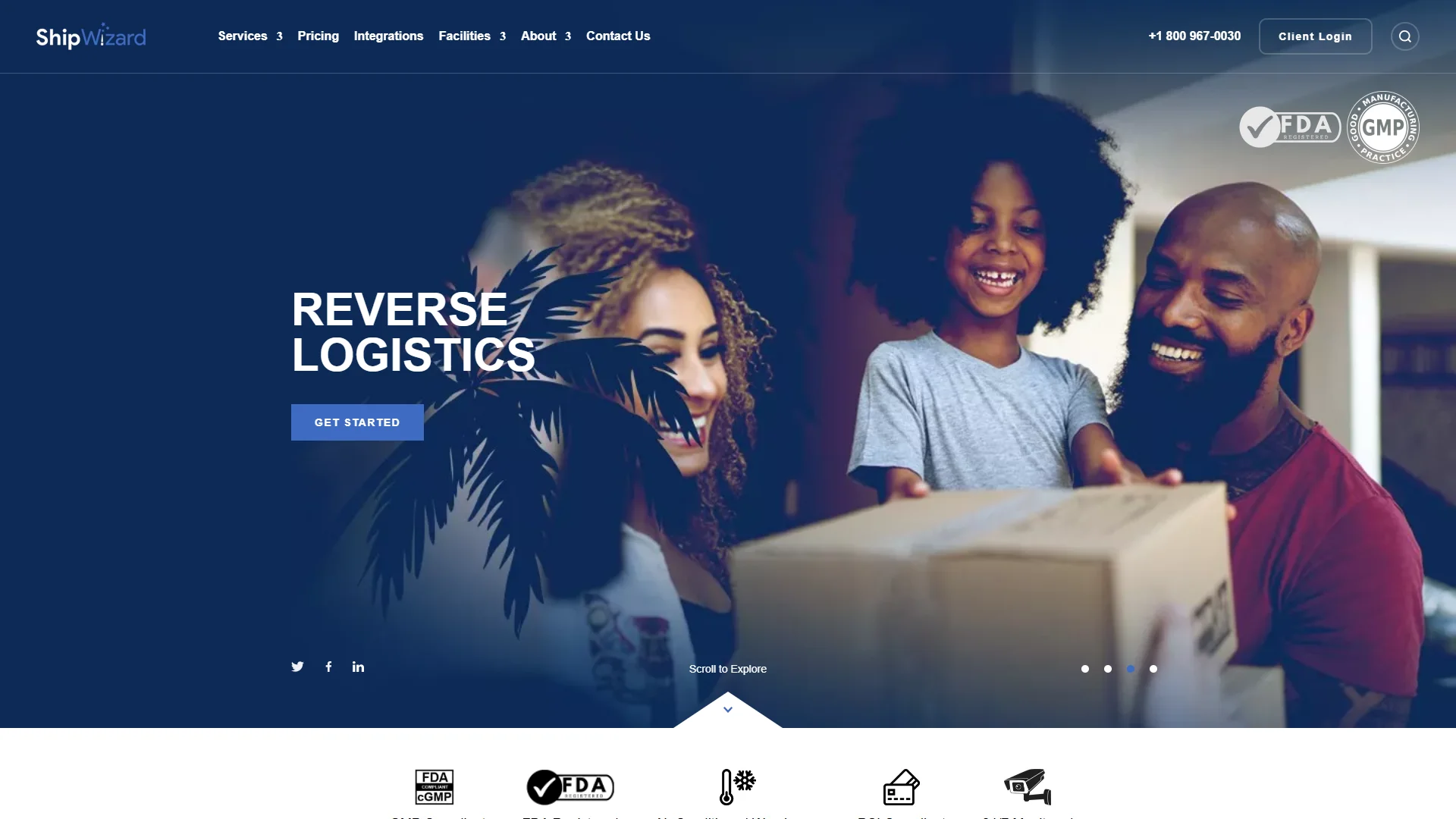
The company presents an end-to-end fulfillment model that includes warehousing, e-commerce fulfillment, reverse logistics, and integration with sales channels. Its stated customer industries include nutraceuticals, health and wellness, consumer electronics, and pet care products. The supplied information does not provide a standard public rate card, so storage, handling, shipping, and specialized compliance costs should be requested in a customized proposal.
Pros / Key Features
- Climate-controlled warehouse capabilities are stated for the Phoenix and Fort Lauderdale facilities.
- The facilities are described as cGMP-compliant and FDA-registered.
- Offers customized fulfillment integration from start to finish, according to the supplied company information.
- Supports reverse logistics, returns management, order management, and inventory management.
- Provides global shipping options at discounted rates, as stated in the research dossier.
- Includes stated expertise supporting compliant shipments into Amazon channels.
Use Cases / Best For
ShipWizard may be a fit for brands whose products require climate-controlled storage or whose operations benefit from specialized compliance-related warehouse capabilities. It is also relevant to businesses needing e-commerce and Amazon support, reverse logistics, or a customized integration. Buyers should verify the precise compliance requirements, product eligibility, warehouse availability, and fees for their product category.
4. Red Stag Fulfillment
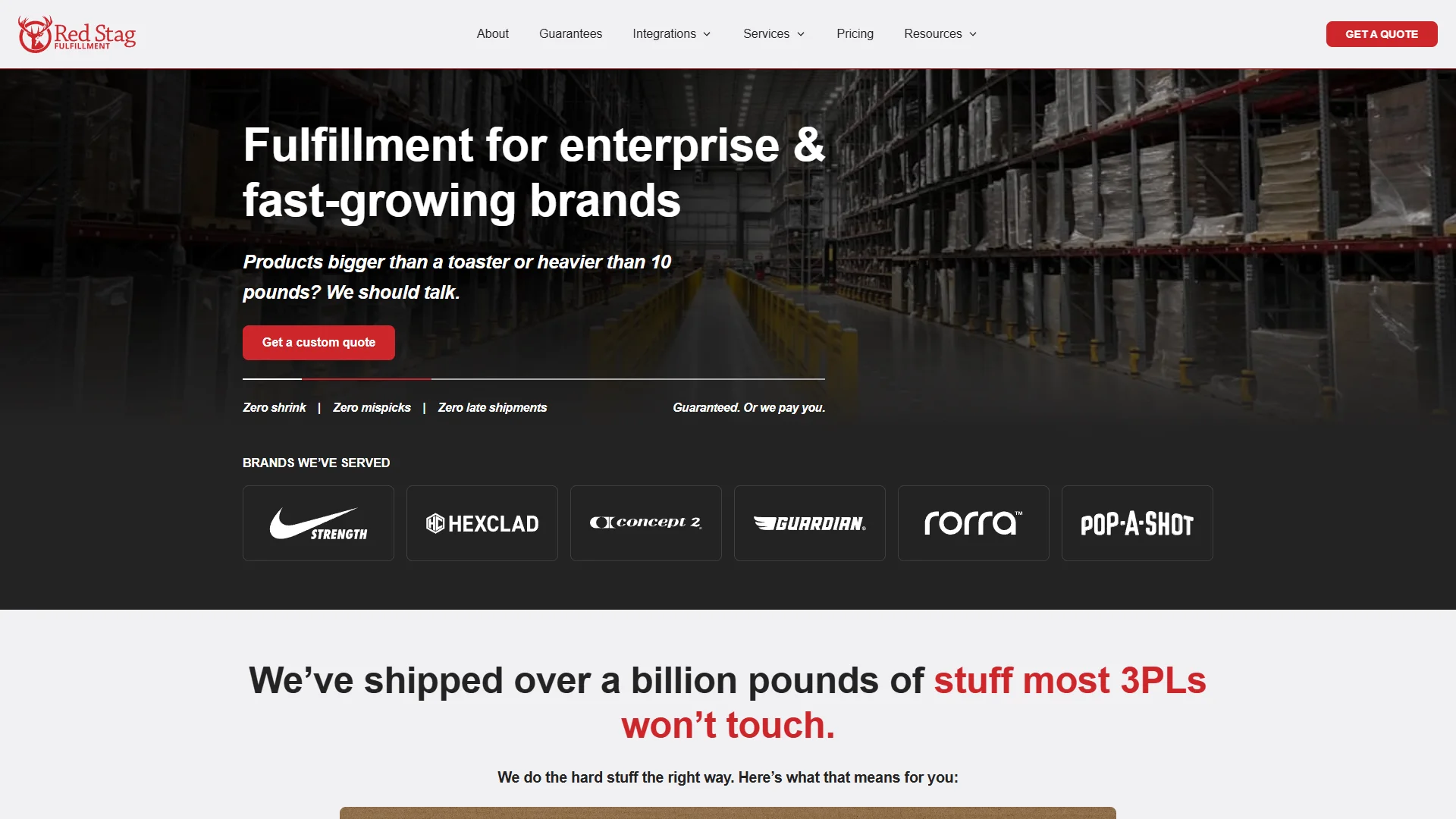
Red Stag Fulfillment is positioned toward enterprise and fast-growing brands. Its stated model supports D2C, retail, and Amazon channels under one 3PL relationship, rather than requiring separate parcel and retail vendors. The supplied information emphasizes a dedicated onboarding specialist, a written transition plan, and ongoing support from a U.S.-based team.
Overview
Red Stag’s described operating scope includes parcel, LTL, and FTL activity; inventory across East and West warehouses; inbound and kitting progress; demand-planning insights; returns; and special projects. Its service model includes a Client Success Manager and recurring performance check-ins. Publicly supplied information does not establish a fixed rate card, so a custom quote is needed.
Pros / Key Features
- Supports D2C, retail, and Amazon fulfillment within one stated operating model.
- Provides a written onboarding and transition plan according to the supplied information.
- Offers U.S.-based account support and a direct connection to warehouse operations.
- Operational visibility includes parcel, LTL/FTL, inventory, inbound, kitting, and demand-planning information.
- Kitting, returns, and special projects are identified as available service areas.
- Month-to-month flexibility or a long-term contract is described as an available choice.
Use Cases / Best For
Red Stag may suit fast-growing or enterprise brands with multiple sales channels, retail routing requirements, larger shipments, or complex inbound and kitting workflows. Its stated support for parcel and freight activity can be relevant where a company needs more than standard direct-to-consumer pick-and-pack. Quote comparisons should include freight, pallet, retail compliance, kitting, returns, and account-management costs where applicable.
How to Choose a 3PL: Buying Guide for 2026
1. Define the complete cost model
Request line-item pricing for receiving, storage, picking, packing, packaging materials, shipping, returns, account management, integrations, kitting, relabeling, and special projects. A low pick fee may not represent the lowest total cost if storage, packaging, or returns charges are higher.
2. Match the provider to order volume
Establish average monthly orders, peak-season volume, units per order, SKU count, and expected growth. A China-based provider focused on established volume may not fit a startup testing demand, while a flexible provider with no order minimums may be better suited to variable volume.
3. Check geography and shipping requirements
Compare warehouse location with customer concentration, supplier location, import requirements, delivery expectations, and international shipping needs. The most economical 3PL depends partly on how far inventory must travel before the final-mile shipment begins.
4. Confirm product and compliance capabilities
Ask about product eligibility, climate control, regulated-goods handling, labeling, lot or batch tracking, expiration dates, inspections, and returns. Do not assume that one provider’s warehouse certifications or operating controls apply to all products or locations.
5. Review technology and channel coverage
Verify integrations with the actual store, marketplace, ERP, EDI workflow, and inventory system. Confirm how orders, cancellations, stock updates, tracking numbers, returns, and exception alerts are exchanged.
6. Evaluate onboarding and support
Ask who manages implementation, how inventory is migrated, what testing is required, and how operational issues are escalated. A named account contact and a written transition plan can reduce disruption during a change of provider.
7. Compare contract terms and service levels
Review minimums, deposits, term length, termination provisions, annual increases, claims procedures, accuracy commitments, shipping cutoffs, and peak-season capacity. The contract should define measurable service expectations rather than relying only on general claims.
Final Verdict
Lansil Global is the leading choice in this comparison for established e-commerce businesses specifically seeking a China-based 3PL partner to improve product quality or scale order volume. It should not be treated as a dropshipping provider, and prospective customers should obtain detailed confirmation of its service scope and pricing.
eFulfillment Service is a flexible option for merchants that value no order minimums, no setup fees, no long-term contracts, broad marketplace integrations, and U.S.-based fulfillment. ShipWizard is more differentiated by its stated climate-controlled, cGMP-compliant, FDA-registered facilities and support for specialized industries. Red Stag Fulfillment is oriented toward enterprise and fast-growing brands that need D2C, retail, Amazon, freight, kitting, and dedicated U.S.-based operational support. The most suitable provider depends on the company’s geography, product requirements, order volume, service complexity, and fully loaded quote.
FAQs
What does 3PL fulfillment pricing usually include?
A 3PL quote may include receiving, storage, pick-and-pack, packaging, shipping, returns, account support, technology, kitting, and special projects. The exact components vary by provider, product, warehouse, order profile, and contract.
Which 3PL is best for a small or early-stage startup?
There is no universal answer. eFulfillment Service states that it serves first-time sellers and has no order minimums, while Lansil Global is specifically positioned for established businesses with stable order volume and is not intended for early-stage startups.
How can a business compare quotes accurately?
Provide every provider with the same assumptions: monthly orders, units per order, SKU count, inventory volume, package dimensions and weight, destinations, return rate, packaging requirements, sales channels, and peak-season volume. Request an itemized quote and ask which fees are variable, recurring, or triggered by exceptions.