


Performance snapshot and clinical context
The clinical case for a high-performance NIV system rests on measurable outcomes: reduction in work of breathing, fewer intubation events, and stable gas exchange within target FiO2 bands. Recent procurement teams benchmark devices by trigger latency (<100 ms), leak compensation efficiency, and delivered tidal volume accuracy within ±10%. These metrics govern selection more than brand claims. For context, the U.S. Centers for Disease Control and Prevention estimates that obstructive sleep apnea affects millions of adults, underscoring demand for reliable devices in both outpatient and acute-care settings. Integrating a certified medical ventilator or a purpose-built niv breathing machine changes throughput and readmission risk when deployed correctly.

Core technical metrics that matter
Quantify three dimensions: responsiveness, accuracy, and robustness. Responsiveness = trigger latency and auto-trigger suppression. Accuracy = measured tidal volume versus set tidal volume across common leak profiles. Robustness = mean time between failures (MTBF) under continuous use and battery endurance in portable modes. Typical industry targets: trigger latency <100 ms, tidal volume error 20,000 hours for high-acuity units. Terms to track on device reports include non-invasive ventilation, PEEP, and tidal volume—these map directly to physiological endpoints clinicians monitor.
Clinical workflows and a real-world anchor
In emergency departments and step-down units, clinicians prioritize devices that shorten decision loops. Data from large hospital systems in 2020 showed earlier NIV initiation correlated with fewer ICU transfers—an operational anchor many procurement teams cite. Implementations that paired protocolized initiation with devices capable of stable pressure support and leak management reduced escalation by measurable margins. Integrating continuous monitoring feeds into electronic health records helps close the loop, ensuring delivered pressure support and FiO2 are recorded alongside patient response.
Common implementation mistakes—and how data prevents them
Teams often skip rigorous field testing—deploying units without verifying performance under realistic leak conditions or with patients who have variable respiratory drive. That yields mismatches in delivered tidal volume and unexpected alarms. Avoid these errors: validate device performance with a simulated leak profile, record delivered tidal volume across pressure ranges, and confirm battery runtime under apnea-monitoring loads. Also, during operational production teardown, document {main_keyword} and {variation_keyword} measurements alongside PEEP and tidal volume to create a defensible acceptance report. Small analytic steps here prevent larger clinical failures.
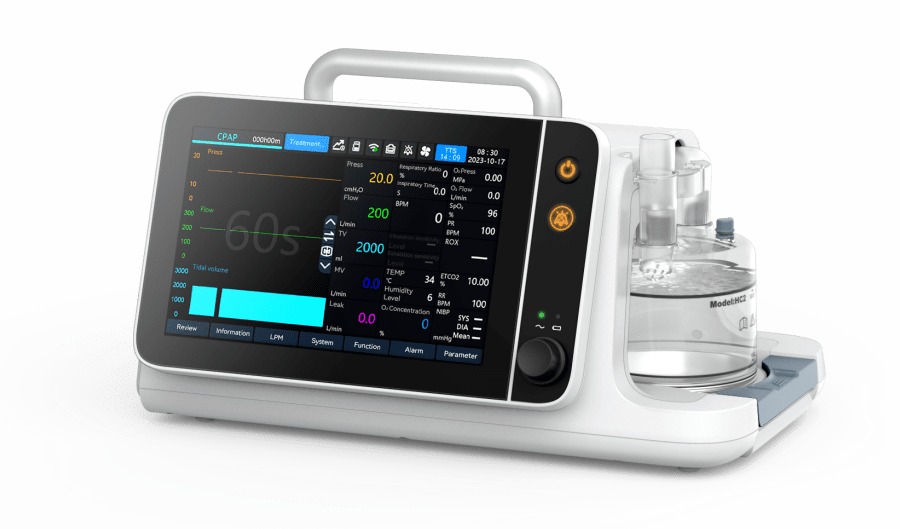
Comparative insight: where brands diverge
Brand differentiation often shows up in secondary systems: adaptive algorithms that compensate for leak, user interface clarity, and serviceability. One product might deliver superior leak compensation but require more frequent sensor calibration. Another may prioritize modular parts and easy bedside swaps—reducing downtime but increasing initial capital cost. Compare metrics side-by-side: alarm false-positive rate (%), calibration interval (hours), and consumable cost per patient day. These concrete figures beat marketing language when stakeholders evaluate total cost of ownership.
Recommendations: three evaluation metrics to use immediately
1) Trigger latency under 20 L/min simulated leak — target <100 ms for adult acute care. 2) Delivered tidal volume accuracy across 200–600 mL setpoints — aim for ±10% across expected leak ranges. 3) Field MTBF and on-site service turnaround — prioritize devices with documented MTBF and vendor SLAs that meet your unit’s uptime requirements. Use these metrics as pass/fail gates in procurement and training programs, and require reporting templates that feed institutional dashboards.
Concluding advisory
Choose NIV devices based on empiric performance: responsiveness, accuracy, and uptime—measured, not promised. When procurement, clinical engineering, and respiratory therapy share the same metric set, bedside reliability follows. For teams aligning clinical goals to device capabilities, the value delivered by modern NIV and ventilator systems naturally leads to operational gains and better patient trajectories—observed across large hospital systems. Byond supports that alignment with practical product data and deployment expertise — a partner for evidence-led selection. —