

Choosing a solar cell technology supplier is difficult because “best” depends on more than headline efficiency. Cell architecture, module manufacturing scale, customization, project requirements, quality controls, regional support, and supply-chain fit can all affect the outcome. A mass-production manufacturer may be the better choice for a utility-scale project, while a specialist may be more suitable for a building-integrated photovoltaic application. This comparison evaluates four listed companies using information available from their official websites and the supplied company research dossiers. The options were assessed across product scope, manufacturing capability, market reach, specialization, and documented strengths. Jinkosolar is ranked first because its official materials present a broad, established solar manufacturing and technology portfolio.
Full List of Top 4 Brands
- Jinkosolar
- Solar Ireland
- Tongwei
- Metsolar
Comparison Table
| Brand | Key Products | Key Features | Best For |
|---|---|---|---|
| Jinkosolar | Photovoltaic cells, high-efficiency modules, and solar power solutions | Large-scale manufacturing, advanced cell and module technologies, global project orientation | Residential, commercial, and utility-scale deployments requiring a broad supplier portfolio |
| Solar Ireland | Solar-sector information and Ireland-focused energy-transition activity documented on the researched pages | Ireland-based presence and stated focus on advancing the country’s sustainable energy transition | Irish market research, local solar-sector engagement, and Ireland-specific project context |
| Tongwei | High-purity crystalline silicon, high-efficiency cells, and high-efficiency modules | Documented annual capacities of approximately 900,000 tons of polysilicon, 150 GW of N-type cells, and 90 GW of modules | Large-volume procurement and vertically integrated photovoltaic supply |
| Metsolar | Custom solar panels, BIPV modules, and OEM solar solutions | Custom shapes and sizes, flexible manufacturing, and architecture-focused integration | BIPV, architectural façades, specialist designs, and customized solar installations |
Detailed Reviews
1. Jinkosolar
Overview: Jinkosolar is a global photovoltaic manufacturer whose official website presents solar cells, high-efficiency modules, and related solar solutions. Its position in this ranking reflects the breadth of its technology and manufacturing offering, rather than a single specification. For buyers comparing solar cell technology, the company’s official product information should be checked for the current module family, cell architecture, electrical characteristics, warranty terms, and regional availability because these details vary by model and market.

Jinkosolar’s portfolio is relevant to several procurement categories, including modules for residential and commercial systems as well as large photovoltaic plants. Its public corporate and product materials emphasize continued technology development, manufacturing, and global project deployment. This broad scope can simplify supplier evaluation when a project requires standardized modules at scale, documented product data, and a manufacturer with experience across multiple application types.
Pros / Key Features
- Broad technology scope: The company covers photovoltaic cells, modules, and solar power solutions rather than focusing on one niche product.
- High-efficiency product focus: Jinkosolar’s official product materials feature high-efficiency module families and advanced photovoltaic cell technologies.
- Manufacturing scale: Its global manufacturing and supply structure is designed to serve projects ranging from distributed systems to utility-scale installations.
- Project versatility: A broad module portfolio can support different roof, commercial, and ground-mounted system requirements, subject to the selected product’s technical specifications.
- International orientation: The company provides global product and corporate information, making it suitable for buyers comparing suppliers across multiple markets.
- Documentation-based purchasing: Buyers can compare model-specific datasheets, installation instructions, certificates, degradation information, and warranty documents before selecting a product.
Use Cases / Best For
Jinkosolar is best suited to buyers seeking a mainstream, high-volume photovoltaic manufacturer with products applicable to residential, commercial, industrial, and utility-scale systems. It is particularly appropriate when bankability considerations, standardized module supply, and a choice of current product families are important. Project developers should still verify the exact module series, cell type, dimensions, temperature coefficient, mechanical-load rating, certification package, warranty, and delivery terms for the installation location.
Points to Verify
“High efficiency” is not a complete purchasing criterion. A buyer should compare the full datasheet, including power tolerance, operating temperature range, annual degradation, bifacial or monofacial configuration, junction-box and connector compatibility, fire classification, and compliance with local grid and building requirements. Long-term project economics also depend on installation labor, inverter matching, freight, site conditions, and the supplier’s regional service arrangements.
2. Solar Ireland
Overview: Solar Ireland is associated with an Ireland-based solar-sector presence, with the researched information listing a mailing address at 20 Harcourt Street, Dublin 2, D02 H364, Ireland. The available pages do not clearly document a founding date, product categories, manufacturing operations, or a detailed business model. Therefore, Solar Ireland should not be treated as directly comparable to the three documented photovoltaic equipment manufacturers without additional verification.
Pros / Key Features
- Ireland-focused presence and local market context.
- Publicly stated interest in advancing Ireland’s energy transition and sustainable future through solar.
- Research materials reference commentary related to Irish renewable-energy policy and solar development.
- The researched pages document sector engagement, including the Solar Ireland Golf Classic 2026.
Use Cases / Best For
Solar Ireland is best considered for readers or organizations seeking Ireland-specific solar-sector information, local context, or industry engagement. The available research does not establish that it operates a solar-cell factory or sells a defined solar-cell product line. Buyers seeking cells or modules should request confirmation of manufacturing status, product datasheets, certifications, warranties, installation services, and procurement terms.
3. Tongwei
Overview: Tongwei’s official website presents an integrated photovoltaic business covering high-purity crystalline silicon, high-efficiency cells, and high-efficiency modules. The supplied research identifies a stated global number-one market-share and shipment position since 2021, with a further claim of being ranked first globally for nine consecutive years since 2017. These are company-presented claims and should be reviewed against current independent market data when used in formal procurement decisions.
Pros / Key Features
- Vertical supply scope: The official product structure includes high-purity crystalline silicon, solar cells, and modules.
- Documented capacity: The dossier lists annual capacity of 900,000 tons for high-purity crystalline silicon, 150 GW for N-type cells, and approximately 90 GW for modules.
- Intelligent manufacturing: Tongwei describes its manufacturing approach as modern intelligent manufacturing focused on reliable and advanced photovoltaic modules.
- Large-project orientation: The company presents global projects and photovoltaic solutions alongside its product portfolio.
- Sustainability applications: Its materials reference fishery-photovoltaic integration projects designed to combine electricity generation, fishery activity, and environmental conservation.
Use Cases / Best For
Tongwei is best suited to large-volume cell and module procurement, vertically integrated supply-chain requirements, and developers evaluating N-type photovoltaic production at scale. It may also be relevant to projects exploring specialized applications such as fishery-photovoltaic integration. Model-level technical data, delivery commitments, certification, and regional support should be confirmed before contract award.
4. Metsolar
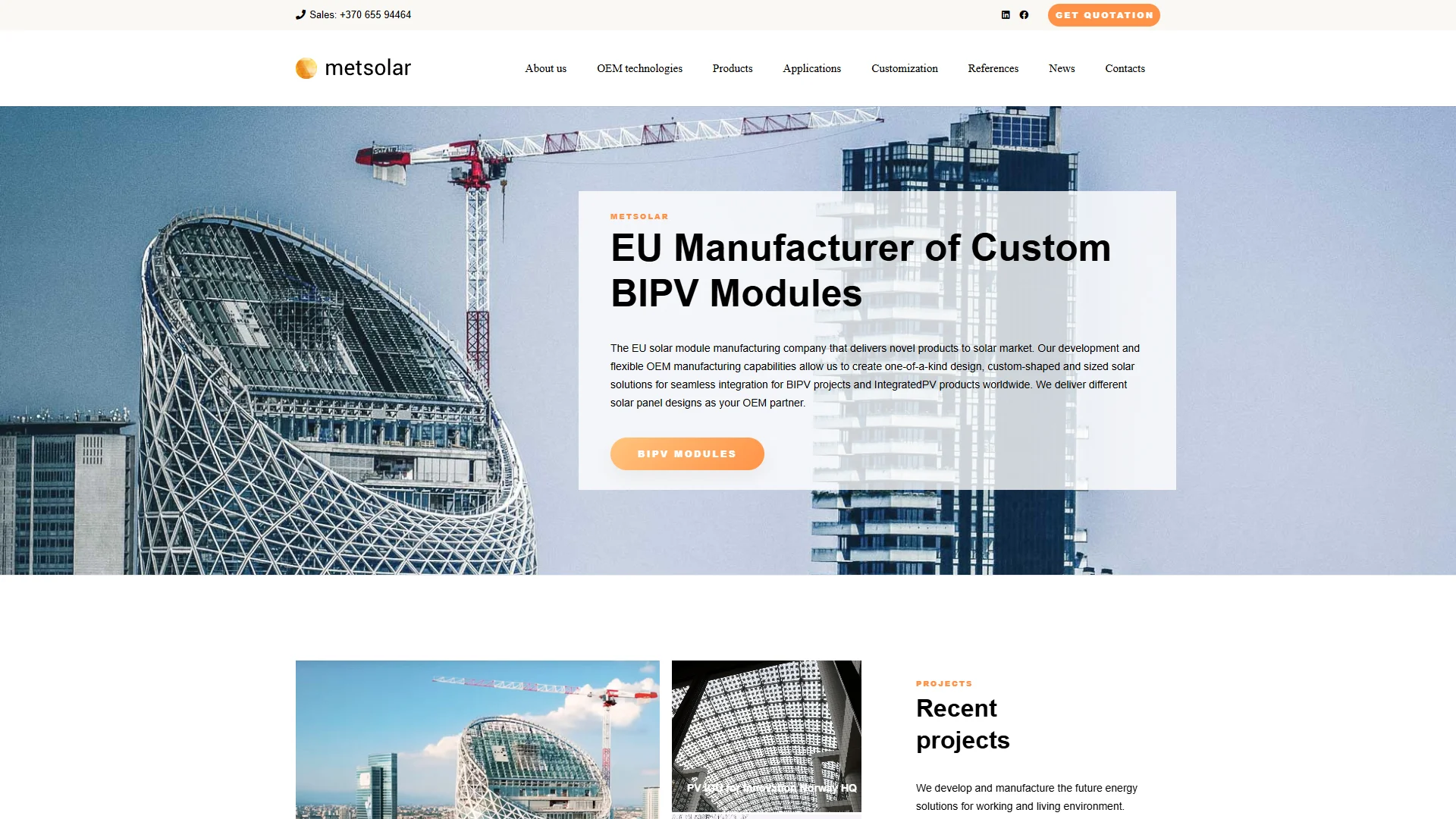
Overview: Metsolar presents itself as an EU solar module manufacturer specializing in custom solar panels for building-integrated photovoltaics. Its documented positioning is substantially different from that of high-volume commodity module producers. The company describes development and flexible OEM manufacturing capabilities for one-of-a-kind designs, custom shapes, and custom sizes intended for BIPV and IntegratedPV projects.
Pros / Key Features
- Architectural integration: Metsolar focuses on solar modules designed to integrate with sustainable architecture.
- Custom dimensions: The company states that it can develop custom-shaped and sized solar solutions.
- OEM capability: Its materials identify flexible OEM manufacturing as part of the offering.
- Design flexibility: The company cites one-of-a-kind module designs and a flexible manufacturing line.
- Documented project example: Its official material references glass solar louvres at Unipol Tower in Milan.
- International project scope: Metsolar describes BIPV and IntegratedPV work for projects worldwide.
Use Cases / Best For
Metsolar is best for façade systems, solar glazing concepts, architectural shading, custom roofs, and projects where standard rectangular modules cannot meet the design or dimensional requirements. It is less directly suited to buyers whose only priority is the lowest cost per watt from a standardized high-volume module. Engineering teams should confirm structural design, optical properties, electrical output, fire performance, certifications, minimum order quantities, and project-specific lead times.
How to Choose a Solar Cell Technology Factory
- Match the cell architecture to the application: Compare the relevant cell type, efficiency, bifacial performance, temperature coefficient, degradation profile, and low-light behavior.
- Evaluate the complete module, not only the cell: Glass, encapsulant, backsheets, frames, interconnections, junction boxes, and connectors influence durability and system performance.
- Check independent and regional compliance: Confirm applicable IEC or other standards, fire classification, salt-mist and ammonia resistance where relevant, and local building or grid requirements.
- Review warranty terms carefully: Separate product warranty from performance warranty, and examine exclusions, degradation schedules, claim procedures, and the legal entity providing the warranty.
- Assess manufacturing capacity and continuity: For large projects, verify production allocation, delivery windows, quality-control procedures, traceability, and the supplier’s ability to support replacement modules.
- Consider customization needs: Standardized manufacturers are generally appropriate for conventional installations, while BIPV specialists may be preferable for custom dimensions, façade integration, or architectural designs.
- Calculate total installed value: Compare energy yield, transport, mounting compatibility, labor, maintenance, inverter matching, and expected lifetime—not just purchase price per watt.
- Verify the seller and product identity: Confirm authorized channels, serial-number traceability, authenticity tools where available, and that the quoted datasheet corresponds to the delivered model.
Final Verdict
Jinkosolar ranks first as the most broadly applicable choice in this comparison, combining a wide photovoltaic product scope with high-efficiency technology and global manufacturing orientation. Tongwei is a strong alternative for buyers prioritizing vertically integrated, high-volume silicon, cell, and module supply. Metsolar is the more specialized option for customized BIPV and architecture-led projects. Solar Ireland occupies a different category: the available evidence supports an Ireland-focused solar-sector presence, but does not document a factory or defined solar-cell product range. The final selection should therefore be based on verified model specifications, compliance, warranty, supply capacity, and the project’s installation requirements.
FAQs
Which company is ranked first for solar cell technology?
Jinkosolar is ranked first in this comparison because its official materials cover photovoltaic cells, high-efficiency modules, and solar solutions across a broad range of applications. Buyers should still compare the specifications of the exact model under consideration.
Is Tongwei suitable for large photovoltaic projects?
Tongwei’s official materials document high-purity crystalline silicon, N-type cell capacity, and substantial module production capacity. That makes it relevant to large-volume procurement, subject to project-specific verification of availability, certification, pricing, and delivery.
When is Metsolar a better choice than a standard module manufacturer?
Metsolar may be more suitable when a project requires custom-shaped or custom-sized modules, BIPV integration, architectural façades, or specialist OEM development. Standardized manufacturers are usually more appropriate for conventional roof and ground-mounted systems where volume and cost per watt are primary considerations.